§ 1Thesis
The semi-sharp bettor faces a fundamental challenge in evaluating their own system:
realized metrics (ROI, P/L) are noisy on small sample sizes. Standard
n = 100–500 bets is insufficient to separate true edge
from random fluctuation.
The solution is to use a leading indicator that measures the quality of entry into a bet independent of random event outcomes. In value betting, this metric is Closing Line Value (CLV).
The thesis of this document in three points:
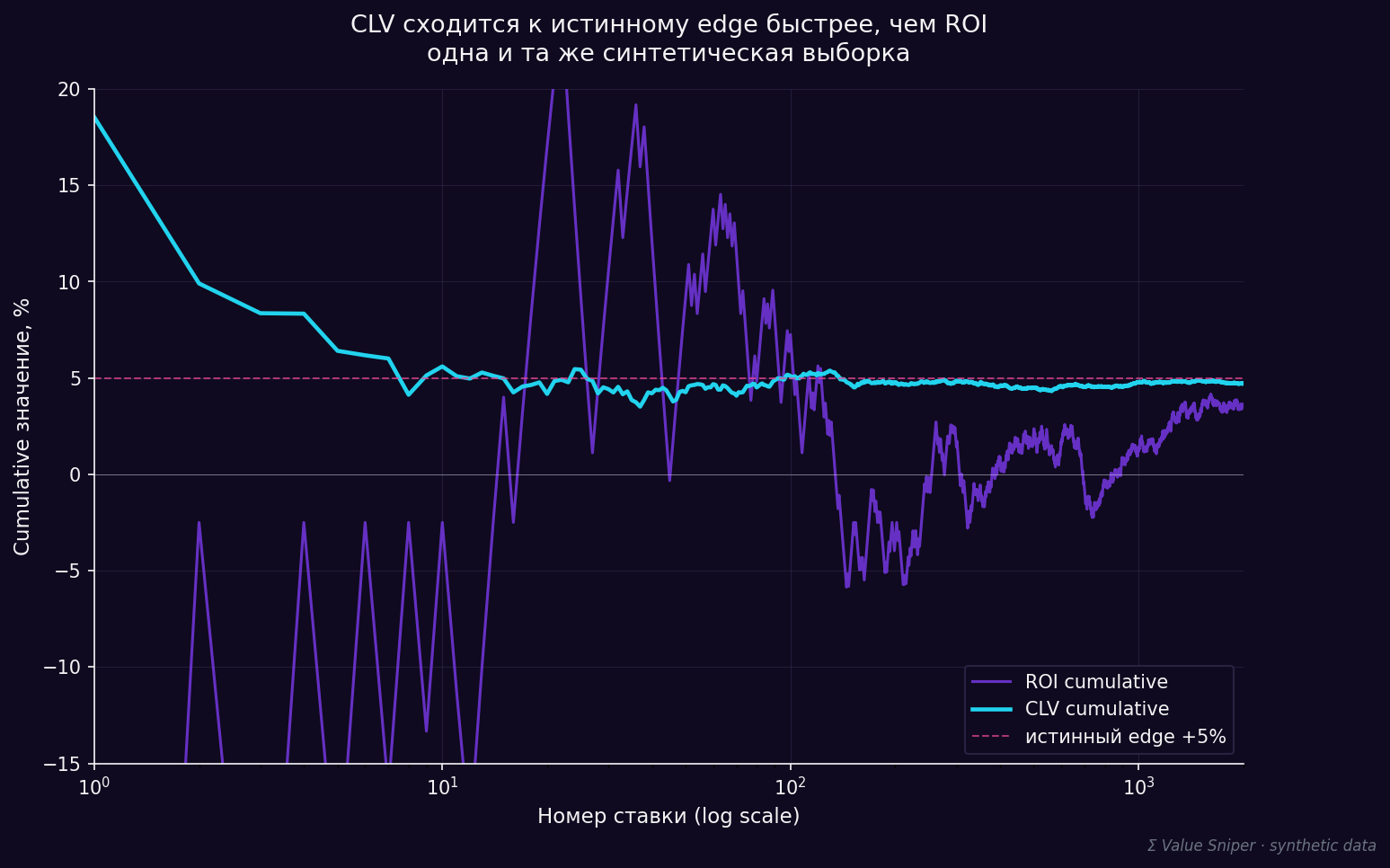
- ROI on samples
n < 500bets is uninformative due to high variance; - CLV stabilizes at
n ≈ 50–200and is a leading indicator of future ROI; - Therefore, to assess system quality we use CLV; ROI is tracked for reference.
Formal definition: CLV is the percentage difference between the odds at entry into a bet and the closing line odds at a sharp bookmaker.
Below — definitions, formulas, sharp consensus methodology, bet sizing, metrics checklist.
§ 2Closing line and sharp bookmakers
Closing line — the final odds before the event starts. Closing contains maximum information: by this point the line has absorbed sharps' opinions, public money flows, and late-breaking news (injuries, weather, lineups).
Why closing is more important than opening. The opening line reflects only the bookmaker's view before trading begins. Between opening and closing the market digests enormous amounts of information: early sharp entries, newsfeed reactions, bookmaker rebalancing in response to public money. By closing, the line is at the point of greatest consensus.
Therefore, when assessing CLV, we always compare to the closing line, not opening. The opening is too volatile and weakly informative.
Sharp bookmakers — bookmakers that maintain low margins (~ 2–3%),
accept large stakes, and don't ban winning accounts. Their line approaches the efficient market hypothesis
for sports.
| Bookmaker | Type | Margin |
|---|---|---|
| Pinnacle | traditional bookie, sharp-friendly | ~ 2.6% |
| Betfair Exchange | peer-to-peer exchange | ~ 2.8% |
| Matchbook | peer-to-peer exchange | ~ 3.0% |
Standard value betting practice: use Pinnacle's closing line as reference. Advanced practice — median of three sharps (see § 5).
§ 3CLV: formula and interpretation
Basic CLV formula in terms of odds:
CLV = (k_entry / k_close) − 1
where k_entry — odds at entry time,
k_close — closing line at the sharp reference.
Numerical example (conditional):
k_entry = 1.95 (taken from a soft bookie)
k_close = 1.85 (Pinnacle closing line)
CLV = (1.95 / 1.85) − 1 = +5.4%
Positive CLV means: you entered at more favorable odds than the correct level at the moment of start. Over distance this converts to positive expected value of the bet.
Alternative formulation via implicit probabilities:
p_entry = 1 / k_entry (without de-vig)
p_close = 1 / k_close (without de-vig)
CLV_prob = p_close − p_entry
CLV_prob shows how many percentage points lower your probability estimate is versus the market at the moment of start.
When to de-vig. For academic precision in probability calculation you need to subtract
the margin from the odds (de-vig). In practice with Pinnacle at 2.6% margin the difference between
rough 1/k and fair de_vig(k) is small. More detail — in a separate article
on Habr Sharp consensus: the mathematics of three-line median.
⌬§ 4. Why CLV converges faster than ROI
§ 5Sharp consensus: beyond a single Pinnacle
Using a single Pinnacle as reference works but has vulnerabilities:
- Stale lines. Pinnacle sometimes fails to update line on niche markets;
- Operational failures. Technical downtime, trader errors;
- Low liquidity. Low limits on niche matches restrict accuracy.
Solution — median of three sharps. We use
median(Pinnacle, Betfair Exchange, Matchbook) as the reference closing line.
Median is robust to one outlier.
When line discrepancies exceed a threshold (sharp_spread > N pp) —
the signal is considered less reliable or discarded.
Detailed methodology description — in a separate article on Habr Sharp consensus: the mathematics of three-line median (publication in progress).
§ 6Bet sizing
Basic Kelly formula:
f* = (b·p − q) / b
where f* — optimal bankroll fraction, b = k − 1 — net win,
p — win probability, q = 1 − p.
Numerical example:
k = 2.0 → b = 1.0
p = 0.55 → q = 0.45
f_full = (1.0 × 0.55 − 0.45) / 1.0 = 0.10 → 10% of bankroll
Full Kelly maximizes the expected log of bankroll over infinite horizon. However:
- Full Kelly requires exact probability estimate. A ±5% error already kills the bankroll;
- Drawdowns along the trajectory are huge: median(drawdown) with full Kelly ~ 50%;
- Most sharp bettors use fractional Kelly =
0.25 × f*.
Standard practice:
f_quarter = 0.10 × 0.25 = 0.025 → 2.5% of bankroll
Additional cap — 1.5–2% per bet to avoid concentration even at 1/4 Kelly
on signals with high edge.
§ 7What to watch in your own trading
Minimal set of metrics for a sharp bettor:
| Metric | Target | Alert |
|---|---|---|
| CLV per bet | median > 0 | < 0 on average |
| % positive CLV | 70–90% | < 60% |
| Avg CLV cumul (50) | ≥ +3–5% | < +3% |
| ROI cumul | informative | — |
| Bootstrap CI95 ROI | doesn't cross 0 at n=2000 | CLV<0 at CI>0 — sus |
| Drawdown max | < 30% | > 30% |
| Avg sharp margin | 2–4% | > 5% |
Exit rules (stops):
CLV < +3%over last 50 bets → filter review;ROI < −5%over 200 bets with positive CLV → check slippage, limits;Avg sharp margin > 5%over 7 days → pause.
Full metrics catalog — in PDF 2b Metrics and Methodology.
Sigma Further reading
This document is an introduction to CLV methodology. If you want to go deeper:
- PDF 2b Metrics and MethodologyFull catalog: CLV family, sharp_spread, EV thresholds, bootstrap CI, drawdown.
- PDF 2c From ROI to CLVPsychological + methodological angle. Why people cling to ROI and how to re-train yourself.
- Habr articles (in progress)Sharp consensus: the mathematics of three-line median, De-vig by proportional method.
- Sigma Pulse in TG @value_sniper_researchDaily updates: line moved alerts, news adjustment, methodological notes.
- Public track record
alexwhiplash.github.io/value-sniper-public— all settled bets with CLV calculation.
Sigma CLV — the only honest metric.
§ 1Тезис
Полу-sharp беттер сталкивается с базовой проблемой оценки собственной системы:
реализованные метрики (ROI, P/L) шумны на коротких выборках. Стандартное
n = 100-500 ставок недостаточно, чтобы отделить настоящий edge
от случайной флуктуации.
Решение — использовать опережающую метрику, которая измеряет качество входа в ставку независимо от случайной реализации событий. В value-беттинге такой метрикой является Closing Line Value (CLV).
Тезис документа в трёх пунктах:
- ROI на выборке
n < 500ставок неинформативен из-за высокой дисперсии; - CLV стабилизируется на
n ≈ 50-200и является опережающим индикатором будущего ROI; - Поэтому для оценки качества системы используется CLV; ROI отслеживается справочно.
Формальное определение: CLV — процентная разница между коэффициентом входа в ставку и коэффициентом закрытия линии у sharp-бука.
Дальше — определения, формулы, методология sharp-консенсуса, размер ставки, чеклист метрик.
§ 2Closing line и sharp-буки
Closing line — последний коэффициент перед стартом события. Closing содержит максимальную информацию: к этому моменту в линию впитаны мнения sharps, объёмы public money, late-breaking news (травмы, погода, lineups).
Почему closing важнее opening. Opening line отражает только мнение book-makers до начала торгов. Между opening и closing рынок переваривает огромное количество информации: ранние входы sharps, реакция на newsfeed, ребалансировка букмекерами в ответ на public money. К моменту closing линия — это «точка наибольшего консенсуса».
Поэтому при оценке CLV сравнение всегда идёт с closing line, не с opening. Стартовая линия слишком волатильна и слабо информативна.
Sharp-буки — буки, которые держат низкую маржу (~ 2-3%),
принимают высокие ставки, не банят winning accounts. Их линия близка к efficient market hypothesis
для спорта.
| Бук | Тип | Маржа |
|---|---|---|
| Pinnacle | классический бук, sharp-friendly | ~ 2.6% |
| Betfair Exchange | биржа peer-to-peer | ~ 2.8% |
| Matchbook | биржа peer-to-peer | ~ 3.0% |
Стандартный приём value-беттинга: использовать closing line у Pinnacle как референс. Расширенный приём — медиана трёх sharps (см. § 5).
§ 3CLV: формула и интерпретация
Базовая формула CLV в терминах коэффициентов:
CLV = (k_entry / k_close) − 1
где k_entry — коэффициент в момент входа,
k_close — closing line у sharp-референса.
Числовой пример (условный):
k_entry = 1.95 (взяли у мягкого бука)
k_close = 1.85 (closing line у Pinnacle)
CLV = (1.95 / 1.85) − 1 = +5.4%
Положительный CLV означает: ты вошёл по более выгодному коэффициенту, чем «правильный» к моменту старта. На дистанции это превращается в положительное матожидание ставки.
Альтернативная формулировка через имплицитные вероятности:
p_entry = 1 / k_entry (без de-vig)
p_close = 1 / k_close (без de-vig)
CLV_prob = p_close − p_entry
CLV_prob показывает, на сколько процентных пунктов твоя оценка вероятности ниже рыночной к моменту старта.
Когда нужно de-vig. Для академически точного расчёта вероятности нужно
вычесть маржу из коэффициента (de-vig). На практике в Pinnacle с маржой 2.6% разница между
«грубым» 1/k и «честным» de_vig(k) мала. Подробнее — в отдельной статье
на Habr «Sharp-консенсус: математика медианы трёх линий».
⌬§ 4. Почему CLV сходится быстрее, чем ROI
§ 5Sharp-консенсус: за пределами одного Pinnacle
Использование одного Pinnacle как референса работает, но имеет уязвимости:
- Стейл-линии. Pinnacle на нишевых рынках иногда не успевает обновить линию;
- Операционные сбои. Технические простои, ошибки трейдеров;
- Слабая ликвидность. Низкие лимиты на нишевых матчах ограничивают точность.
Решение — медиана трёх sharps. Используем
median(Pinnacle, Betfair Exchange, Matchbook) как референс closing line.
Медиана устойчива к одному outlier'у.
При расхождении линий выше определённого порога (sharp_spread > N pp) —
сигнал считается менее надёжным или отбрасывается.
Подробное описание методологии — в отдельной статье на Habr «Sharp-консенсус: математика медианы трёх линий» (готовится к публикации).
§ 6Размер ставки
Базовая формула Kelly:
f* = (b·p − q) / b
где f* — оптимальная доля банка, b = k − 1 — нетто-выигрыш,
p — вероятность выигрыша, q = 1 − p.
Числовой пример:
k = 2.0 → b = 1.0
p = 0.55 → q = 0.45
f_full = (1.0 × 0.55 − 0.45) / 1.0 = 0.10 → 10% банка
Полный Kelly максимизирует ожидаемый логарифм банка на бесконечном горизонте. Однако:
- Полный Kelly требует точной оценки
p. Ошибка ±5% уже убивает банк; - Просадки внутри траектории огромны: median(drawdown) при full Kelly ~ 50%;
- Большинство sharp-беттеров используют fractional Kelly =
0.25 × f*.
Стандартная практика:
f_quarter = 0.10 × 0.25 = 0.025 → 2.5% банка
Дополнительный потолок — 1.5-2% банка на ставку, чтобы избежать
концентрации даже при ¼ Kelly на сигналах с высоким edge.
§ 7Что watchить в собственной торговле
Минимальный набор метрик для sharp-беттера:
| Метрика | Целевое | Тревога |
|---|---|---|
| CLV per bet | median > 0 | < 0 в среднем |
| % positive CLV | 70-90% | < 60% |
| Avg CLV cumul (50) | ≥ +3-5% | < +3% |
| ROI cumul | информативно | — |
| Bootstrap CI95 ROI | не пересекает 0 при n=2000 | CLV<0 при CI>0 — sus |
| Drawdown max | < 30% | > 30% |
| Avg sharp margin | 2-4% | > 5% |
Правила выхода (стопы):
CLV < +3%за последние 50 ставок → пересмотр фильтров;ROI < −5%за 200 ставок при положительном CLV → проверка slippage, лимитов;Avg sharp margin > 5%за 7 дней → пауза.
Полный каталог метрик — в PDF 2b «Метрики и методология».
Σ Дальнейшее чтение
Этот документ — введение в CLV-методологию. Если хочешь глубже:
- PDF 2b «Метрики и методология»Полный каталог: CLV-семейство, sharp_spread, EV thresholds, bootstrap CI, drawdown.
- PDF 2c «От ROI к CLV»Психологический + методологический угол. Почему люди цепляются за ROI и как переучить себя.
- Habr статьи (готовятся)«Sharp-консенсус: математика медианы трёх линий», «De-vig пропорциональным методом».
- Σ Pulse в TG @value_sniper_researchЕжедневные обновления: line moved alerts, news adjustment, методические заметки.
- Публичный track record
alexwhiplash.github.io/value-sniper-public— все settled bets с CLV расчётом.
Σ CLV — единственная честная метрика.